Showing posts with label science. Show all posts

Sunday, 16 August 2020

Visualizing general relativity

Figure 1: The equivalence between gravity and acceleration
This post is part of a series on visualizing relativity.

As noted in the previous post, the first postulate of special relativity states that the laws of motion are the same in all inertial reference frames.

An inertial frame has no external forces acting on it, so either remains at rest or moves at a constant speed along a straight path. It would seem, then, that special relativity is applicable to gravity-free space but not to Earth where objects in free fall accelerate due to gravity.

This brings us to Einstein's thought experiment. Suppose you are in a compartment where you release an apple and observe it fall to the floor (see Figure 1). This occurs for a compartment at rest on Earth, due to gravity. But the same motion of the apple would also be observed if you were out in space and the compartment were accelerating upward at a rate of 9.8 m/s. There is an equivalence between these two scenarios - the laws of motion with respect to the apple are the same in both reference frames.

Now suppose you are in a compartment where you release an apple and observe it stay in the same position. This would occur for a compartment in free fall on Earth. The compartment and all the objects in it would be accelerating at the same rate, due to gravity though, relative to you in the compartment, the apple would be motionless. But the same (lack of) motion of the apple would also occur if you were out in space and the compartment were at rest. Again, there is an equivalence between these two scenarios - the laws of motion with respect to the apple are the same in both reference frames.

This is Einstein's equivalence principle which motivates the general theory of relativity. The laws of motion are the same for the compartment in free fall whether on Earth or in space. If this is so then it would seem that the compartment in free fall on Earth is an inertial reference frame. But, if so, then there can be no external force acting on it. That is, rather than accelerating, it is either at rest or moving at a constant speed along a straight path.

But how can this be? The apple certainly appears to be accelerating. Einstein's answer was that spacetime itself is curved and the apple follows a straight path (geodesic) through curved spacetime. This is illustrated in Figure 2 below (from this animation). In the Newtonian diagram, the apple is initially hanging on a branch. An upward force (green) is holding the apple and gravity (red) is pushing it down. When the apple falls off the branch, gravity pushes it down to the ground. In the Einsteinian diagram, only an upward force (green) is holding the apple which results in a curved trajectory through spacetime. When the apple falls there are no longer any external forces acting on it, so it follows a straight path through spacetime. Indeed, an accelerometer in free fall will measure zero since there are no forces acting on it.

Figure 2: Newtonian gravity vs Einsteinian curved spacetime

So that's the basic idea behind general relativity. A free falling frame is locally equivalent to an inertial frame and a gravitational field is locally equivalent to an acceleration. [1] We perceive the falling apple as accelerating downward but it's really us that are being accelerated upward by the Earth (as an accelerometer shows) and the falling apple's reference frame is inertial.

Let's now return to Alice and Bob from the previous post on special relativity and see how spacetime curvature affects one's predicted measurements of time and space. The following Epstein diagrams have been generated from Adam Trepczynski's relativity app.

Figure 3: Alice after 1 second in her rest frame
Suppose Alice (in her rocket) is motionless in space, far enough away from any massive objects so that there are virtually no gravitational effects. That is, local spacetime is flat.

As shown in Figure 3, Alice has traveled 0 light seconds [2] in space and aged by 1 second.

The yellow coloring indicates her rocket which, with respect to her rest frame, is not rotated in spacetime and is not contracted in length.

The clocks at the bottom indicate the elapsed coordinate time of 1 second (cyan) and Alice's elapsed proper time, or aging, also of 1 second (purple).

Figure 4: Bob after 1 second in Alice's rest frame
Figure 4 shows Bob (and his rocket) as measured by Alice in her rest frame. In 1 second of her proper time, Bob has traveled 0.6 light seconds in space and aged by 0.8 seconds (Bob's proper time).

The yellow coloring indicates Bob's rocket which is rotated in spacetime and is contracted to 0.8 of its rest length as measured by Alice.

The clocks at the bottom indicate the elapsed coordinate time of 1 second (cyan) and Bob's elapsed proper time of 0.8 seconds (purple).

Figure 5: Alice is stationary (in curved spacetime)
So far, I have described what Alice and Bob measure in situations that are unaffected by gravity.

Now suppose that Alice and Bob are on a massive planet that curves spacetime (note: the planet is to the right along the space axis, with the proper time axis bending away from it). Alice is on a rocket launch pad on the top floor of a (very tall) tower, while Bob is on a floor 0.6 light seconds below.

Note that Alice and Bob are being accelerated upward by the planet and tower. Since Alice is stationary (with respect to her spatial position on the planet), she moves only through time, aging by 1 second, as shown in Figure 5.

This is analogous to the apple's motion through spacetime while it is still hanging on the tree branch.

Figure 6: Bob is stationary (in curved spacetime)
Figure 6 shows Bob on the lower floor (i.e., to the right of Alice on the space axis). He ages 0.63 seconds as measured by Alice who has aged by 1 second, and he remains 0.6 light seconds lower in altitude than her.

This is an example of gravitational time dilation. Bob ages less than Alice since he is closer to the gravitating planet. [3]

Figure 7: Alice in free fall (in curved spacetime)
Now Bob catches the elevator to meet up with Alice on the top floor. Alice, in her rocket, launches off the top of the tower. She is initially at rest (with respect to the planet) and in free fall. Figure 7 shows that after 1 second of coordinate time, Alice has traveled 0.41 light seconds in space (downward) and aged 0.79 seconds.

That effect is what we call gravity. While Alice traveled in a straight line at a constant rate, the curvature of spacetime changed her direction from purely through time to partly through space as well. [4]

A way to visualize the diagram in Figure 7 is as a three dimensional truncated cone. The cyan line will no longer appear straight, but will increasingly curve down the cone.

This is analogous to the apple in free fall increasing in speed over time (relative to the tree branch).

Figure 8: Bob in free fall (in curved spacetime)
In Figure 8 Bob, not to be left behind, launches off the top of the tower with an initial downward velocity of 0.6 times the speed of light and in free fall. After 1 second of coordinate time, Bob has traveled 0.79 light seconds in space (downward) and aged 0.46 seconds.

As with Alice, even though Bob is traveling in a straight line at a constant rate, the curvature of spacetime changes his direction to be proportionally more through space than time than if spacetime were flat. Which is to say, Bob ages less and moves further through space than in Figure 4.

So that's the geometry of spacetime according to general relativity.

To review, the special theory of relativity states that the laws of motion are the same in all inertial (non-accelerating) reference frames. But what about accelerating reference frames? Einstein's subsequent insight was that acceleration and gravity are equivalent. Suppose Alice is on a train and experiences a jerk forwards as the result of the train braking. She can interpret this as the deceleration of the train. Or, equivalently, she can interpret herself as being permanently at rest while the world around her moves under the influence of a gravitational field. [5] Gravity, in turn, can be understood as curvature in spacetime. Thus acceleration can be understood as curvature in spacetime.

The consequence is that while any frame can serve as a rest frame (thus generalizing special relativity), the presence of spacetime curvature means that other frames may only be inertial with respect to that rest frame when in its local neighborhood and for a limited time. Keeping that in mind, the following principle can be stated:

General principle of relativity: The laws of motion are the same in all reference frames

So with reference to the general theory of relativity, what does this mean for Alice? It means that her frame can always be interpreted as a rest frame. And any frame that is accelerating with respect to Alice can be explained by the curved geometry of spacetime. Those rules apply equally for Bob, or any arbitrary reference frame.

--

[1] The equivalence principle is a local equivalence - globally, gravity exhibits tidal effects. Consider also two free falling observers on opposite sides of the Earth. Both are in inertial frames yet, globally, they are accelerating towards each other. So measurements can only be compared locally where spacetime is approximately flat. Finally, consider that gravitation obeys the inverse square law and so will not be equivalent to uniform acceleration over large distances.

[2] 1 light second - the distance light travels in 1 second - is about 300,000 km (or 186,000 miles). The circumference of the Earth is about 40,000 km (or 25,000 miles), so light can travel around the Earth 7.5 times per second.

[3] For an analysis of the curvature of the time axis, see Gravitation and the Curvature of Space-Time. (See also Relativity Visualized, p145, and gravitational redshift.)

[4] Recall Epstein's myth from the previous post - Alice is moving at the speed of light through spacetime (as represented by coordinate time t). But as she progresses she is moving less in time and more in space, with the limit being the speed of light through space. That limit can't be reached in coordinate time t, but can be reached in a finite amount of proper time τ. (See also Relativity Visualized, p150.)

[5] My example is drawn from the following passage in Einstein's book, Relativity: The Special and General Theory:
'It is certainly true that the observer in the railway carriage experiences a jerk forwards as a result of the application of the brake, and that he recognises, in this the non-uniformity of motion (retardation) of the carriage. But he is compelled by nobody to refer this jerk to a "real" acceleration (retardation) of the carriage. He might also interpret his experience thus: " My body of reference (the carriage) remains permanently at rest. With reference to it, however, there exists (during the period of application of the brakes) a gravitational field which is directed forwards and which is variable with respect to time. Under the influence of this field, the embankment together with the earth moves non-uniformly in such a manner that their original velocity in the backwards direction is continuously reduced."'
Einstein's thought experiment is similar to Galileo's in the sense that visual cues in the environment are discounted. While the frames can't be differentiated experimentally, an observer would normally differentiate them based on those visual cues (i.e., that the ship is moving on the water and that the train is decelerating). On this view, the observer's alternative interpretation in Einstein's thought experiment introduces a pseudo-gravitational field and does not involve actual spacetime curvature. General relativity is then reserved for real gravitational fields (due to matter) that exhibit as curvature in spacetime.


Glossary


The equivalence principle: The local effects of motion in a curved spacetime (gravitation) are indistinguishable from those of an accelerated observer in flat spacetime.

A geodesic is a straightest-possible line in a surface or a more general space. In the plane, the geodesics are straight lines, on the surface of a sphere they are great circles.

Gravitational time dilation: clocks in the vicinity of a mass or other source of gravity run more slowly than clocks which are farther away.


Resources


Friday, 31 July 2020

Visualizing special relativity

The twin paradox
This post is part of a series on visualizing relativity.

As noted in the previous post, special relativity is based on two postulates:

1. The laws of motion are the same in all inertial frames
2. The speed of light is the same in all inertial frames

The conventional view is that we live in a three-dimensional world where time proceeds at a constant rate for all of us independent of motion. But Einstein's theory shows that we instead live in a four-dimensional spacetime where space and time are interdependent. (Note: technical terms are explained in the Glossary at the end of this post.)

Lewis Carroll Epstein in his book Relativity Visualized presents a myth for intuitively understanding the special theory of relativity. As he puts it:
Why can't you travel faster than light? The reason you can't go faster than the speed of light is that you can't go slower. There is only one speed. Everything, including you, is always moving at the speed of light. How can you be moving if you are at rest in a chair? You are moving through time. (pp78-79)
So, according to the myth, each of us are always travelling at the speed of light through 4D spacetime. Since Alice is always at rest with respect to herself, that sets her time direction. The three directions perpendicular to her time direction are the space directions that she perceives. If Alice changes her velocity, she rotates in spacetime such that she is now at rest with a new time direction.

When Bob is travelling at close to the speed of light, Alice measures Bob as aging slowly (time dilation) and shortened in the direction of motion (length contraction). This is simply the effect of Bob being rotated in spacetime relative to her and then projected onto Alice's coordinate system. But in Bob's (at rest) reference frame, his wristwatch is running normally and his shape and size are normal. This is analogous to how a round table appears oval when viewed from an angle. However the difference with relativity is that the projection is not simply perceptual, but is the outcome of collecting measurements from local observers who use clocks and rulers.

Alice's measurements of Bob from her rest frame can be represented by an Epstein spacetime diagram [1] as shown in Figure 1 below.

Figure 1: Bob is travelling at 0.6 times the speed of light in space (relative to Alice)

Alice's proper time is on the vertical axis, while her space dimension is perpendicular to it on the horizontal axis (note: only the x-space dimension appears - the y-space and z-space dimensions are omitted). A radius represents 1 light year in a particular direction - vertical (for Alice at rest), horizontal (for a photon) or an intermediate direction (for Bob).

Alice travels 0 light years in space and 1 light year in time, i.e., she ages 1 year. At the other extreme, a photon travels 1 light year in space and 0 light years in time, relative to Alice.

According to Alice's measurements, Bob travels 0.6 light years in space. Bob's proper time can be calculated using the Pythagorean Theorem (where coordinate time is the length of the red arrow - Bob's worldline, Bob's proper time is the spacetime interval, and coordinate space is the distance Bob has traveled according to Alice's measurements): [1]

coordinate time2 = Bob's proper time2 + coordinate space2

Solving for Bob's proper time, where the coordinate time (the length of Bob's arrow) is 1:

Bob's proper time = √(coordinate time2 - coordinate space2)
                  = √(12 - 0.62)
                  = √(1 - 0.36)
                  = √(0.64)
                  = 0.8 years (or 9.6 months)


Since Bob has only traveled for 0.8 years at a velocity of 0.6c, the distance he has traveled in his rest frame is less than 0.6 light years. Bob's distance (according to his measurements) can be calculated using the usual distance formula:

Bob's proper space = velocity * Bob's proper time
                   = 0.6 * 0.8
                   = 0.48 light years


Figure 2: Alice is travelling at 0.6 times the speed of light in space (relative to Bob)

In Figure 2, the same situation is shown, but from Bob's (at rest) reference frame. This is achieved by rotating the coordinate system such that Bob's arrow is on the proper time axis. Note that it is now Alice that has aged 0.8 years relative to Bob's 1 year.

These results may seem contradictory - how could it be that Bob has aged less than Alice in Alice's reference frame, but Alice has aged less than Bob in Bob's reference frame? The reason is that the time measurement that each person does of the other is a projection onto their proper time axis. To demonstrate this geometrically, Alice and Bob's reference frames are superimposed in Figure 3. Each observer is at rest, but measures the other moving obliquely. The symmetry is similar to two boats drifting apart from each other, and each perceiving the other as smaller. However, as noted earlier, the difference with relativity is that the projection is measurable, not merely perceptual.

Figure 3: Alice and Bob's reference frames superimposed - the situation is symmetrical

If Alice and Bob meet up and compare notes, they will find no contradiction, i.e., they will be the same age, or just one will be younger than the other. To understand how this works, suppose that Bob returns to Alice at (very close to) the speed of light. His elapsed proper time will then be 0.8 years compared to Alice's now 1.6 years (since Alice ages a further 0.6 years during the return leg, while Bob does not age at all). Symmetrically, suppose that Alice returns to Bob at (very close to) the speed of light. Her elapsed proper time will then be 0.8 years compared to Bob's now 1.6 years. The opposite results in each case are due to the change in reference frames of the traveler (which is, in effect, an acceleration by the traveler that they themselves are able to detect).

These are instances of the famous twin paradox. An Epstein diagram can also show a more common rendering of the twin paradox, where Bob reverses course at the mid-point of his journey and returns to Alice at the same speed.

Figure 4: The twin paradox

In Figure 4, Bob travels the same total distance as in Figure 1, however this time he travels 0.3 light years on the outward journey and 0.3 light years on the return journey (in Alice's frame). As with the example above of Bob returning at the speed of light, Bob ages 0.8 years while Alice ages 1 year.

Figure 5: Alice measures the contracted length of Bob's rocket

In Figure 5, Alice and Bob are part of the way along their respective journeys (note: the solid blue and red arrows are the same length), with the lengths of their respective rockets shown (exaggerated to be visible). Since Bob is traveling relative to Alice, Alice measures Bob's rocket to be shorter than its proper length, as projected on her spatial axis. For example, suppose the proper length of Bob's rocket is 0.1 light years. To calculate the length contraction, Bob's rocket can be rotated a quarter anticlockwise turn to lie along Bob's proper time axis (the red arrow) and projected onto Alice's proper time axis. Since the rocket is 0.1 times the length of the unit line, its projection against the proper time axis is 0.1 * 0.8 = 0.08. Rotating back, its projection against the space axis is also 0.08 light years. [2]

Bob would similarly measure Alice's rocket to be shorter than its proper length. (To see this, rotate the coordinate system such that Bob's arrow is on the proper time axis - then project Alice's rocket onto the spatial axis.)

In summary, both the time dilation and length contraction of an observed entity can be understood as projections onto the observer's proper time and spatial axes respectively. An entity observed by Alice to be travelling very close to the speed of light would be measured as having almost no elapsed time on its clock and almost entirely length contracted.

--

[1] The most common spacetime diagram is the Minkowski diagram. However I've instead used the Epstein diagram here due to its intuitive representation (for a comparison, see Figure 6 below). An Epstein diagram is a space-proper-time diagram that shows the worldlines of objects traveling below the speed of light (i.e., on timelike, but not lightlike or spacelike paths). The basis for the Epstein diagram is explained below.

The Euclidean metric for calculating the total distance between points in 3 dimensional space is:

d2 = x2 + y2 + z2

This is just an application of the Pythagorean Theorem in a Euclidean space. Of interest here is that if a 1 meter ruler is rotated in space, the x, y and z coordinates can all change, but d will remain invariant.

The Minkowski metric for calculating the total "distance" (i.e., the spacetime interval L) between points in 3+1 dimensional spacetime is:

L2 = x2 + y2 + z2 - (ct)2
   = d2 - (ct)2


It can also be expressed with an imaginary term:

L2 = x2 + y2 + z2 + (ict)2
   = d2 + (ict)2


Or, as an alternative convention, the signs can be flipped (omitting the negative sign on L2):

L2 = (ct)2 - x2 - y2 - z2
   = (ct)2 - d2


Minkowski space is non-Euclidean. Of interest here is that if a 1 meter ruler is rotated in spacetime, the x, y, z and t coordinates can all change, but L will remain invariant. Note that when d increases, so does t.

Rearranging the equation:

(ct)2 = L2 + d2

Which looks just like the Pythagorean Theorem! The spacetime interval L is a measure of the observed object's proper time (τ), d is a measure of the traveled distance, c is the speed of light (normalized to 1 in this post) and t is the elapsed coordinate time. Thus:

t2 = τ2 + d2

That is the basis for the Epstein diagram. In essence, Minkowski diagrams represent a hyperbolic equation (τ2 = t2 - d2) that is the difference of squares, whereas Epstein diagrams represent a circular equation (t2 = τ2 + d2) that is the sum of squares.

Figure 6 compares the Epstein and Minkowski diagrams for the twin paradox.

Figure 6: Comparison of Epstein and Minkowski spacetime diagrams

Epstein diagrams are visually intuitive and quantitatively correct. For example, on the Epstein diagram, it is clear that Bob has aged less than Alice since his proper time is shown as less than Alice's proper time when they reunite. Also, the worldlines are the same length, representing the same elapsed coordinate time. Compare with the Minkowski diagram where Bob's shorter proper time is shown by a longer worldline than Alice's.

[2] The geometry is explained here. In particular, note the similar right-triangles indicated by the angle φ. These triangles can be rotated such that their hypotenuse lies along Bob's arrow, allowing the shorter side lengths to be projected onto Alice's axes.


Glossary


An inertial frame is a reference frame that is either at rest or moving at a constant velocity (i.e., not accelerating).

Proper time (or rest time) is the time τ as measured by a clock in a rest frame. On an Epstein diagram (see Figure 6), proper time is represented on the y-axis. On a Minkowski diagram, proper time is represented by the worldlines. While Bob's proper time is shorter than Alice's, it's shown as longer on a Minkowski diagram.

Proper space (proper length, space displacement, rest length, or rest space) is the distance d as measured using standard length rods in a rest frame. On both Epstein and Minkowski diagrams, the observer's proper space is represented on the x-axis.

Coordinate time (or observer's time) is the time t of a moving object measured by an observer at rest. Thus it is the same for all objects. On an Epstein diagram, coordinate time is represented by the worldlines (which are the same length on the diagram). On a Minkowski diagram, coordinate time is represented on the y-axis.

Coordinate space (or observer's length, coordinate length, or coordinate distance) is the distance d that a moving object travels as measured by an observer at rest. Thus it is the same for all objects. On both Epstein and Minkowski diagrams, coordinate space is represented on the x-axis.

Spacetime is a mathematical model that fuses the three dimensions of space and the one dimension of time into a single four-dimensional manifold.

The worldline of an object is the path that the object traces in spacetime.

The spacetime interval between two events is the length of the segment of the worldline connecting the two events. It is invariant, which means that everyone measures the same value.


Resources


Monday, 27 July 2020

Visualizing Galilean relativity

Figure 1: Galileo's ship
This post is part of a series on visualizing relativity.

In 1632, Galileo gave a famous example of a ship travelling at constant velocity, without rocking, on a smooth sea. His claim was that any observer below the deck would not be able to tell whether the ship was moving or stationary.


In Figure 1, an experimenter releases a ball which drops vertically between time t1 and time t2. Does this imply that the boat must be stationary in the water? No, because if the boat is moving at a constant velocity, the ball will also move with that constant velocity (in the boat's direction of movement) and land in the same place, relative to the boat. Thus the experimenter is unable to tell whether the boat is moving at a constant velocity or is stationary.

This result is captured in the following principle:

Galilean relativity: The laws of motion are the same in all inertial frames

An inertial frame is simply a reference frame that is either at rest or moving at a constant velocity (i.e., not accelerating).

Note, however, that from the reference frame of the water (as indicated by the fish at rest between time t1 and time t2), the ball will follow a curved (parabolic) path. That is a measurable relativistic effect (in the Galilean sense).

Figure 2: Adding velocities
In Figure 2, a train is travelling at 100km/h and Bob (on the train) shoots an arrow at 200km/h toward the target. At the same time, Alice (on the ground) also shoots an arrow at 200km/h toward the target.

According to Alice, the velocity of Bob's arrow is the velocity of the train plus the velocity of the arrow according to Bob. That is, Alice would measure the velocity of Bob's arrow to be 100km/h + 200km/h = 300km/h. Thus Bob's arrow would hit the target before hers, even though both arrows had the same velocity in their respective frames of reference.

Figure 3: Adding velocities (light)
In Figure 3, Bob fires a laser that emits photons travelling at the speed of light (c) toward the target. Alice fires her laser at the same time. Alice, it seems, would measure the velocity of Bob's light to be c + 100km/h, and Bob's laser light hitting the target before hers.

However that is not what happens! Instead, the light from both lasers hits the target at the same instant and Alice measures the velocity of Bob's light to be c, just as Bob does.

This surprising result lead Einstein to extend Galilean relativity to include the following postulate:

The Principle of Invariant Light Speed: The speed of light is the same in all inertial frames

Galilean relativity and the principle of invariant light speed together comprise Einstein's special theory of relativity. As you may know, this gave rise to a number of unexpected consequences, including relativity of simultaneity, time dilation, length contraction and a new equation for adding velocities.

The next post will explore those consequences and present a way to intuitively visualize special relativity.

Visualizing relativity

The principle of relativity
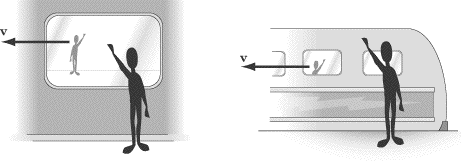
Suppose Alice is standing on a train platform waving her friend Bob goodbye as the train he is on moves away from the platform. From Alice's perspective, she is standing still on the platform while the train is moving away from her. But from Bob's perspective, he is standing still on the train while the platform is moving away from him.

We suppose that Alice and Bob are describing the same situation, as governed by the same laws of nature, but just from a different vantage point. This idea is captured by the principle of relativity:

Principle of relativity: The laws of nature are the same in every frame of reference

In the train example, Alice and Bob each represent a frame of reference. Those reference frames are relative to each other, hence the name of the principle. And the train scenario is governed by natural laws that are invariant across those reference frames.

This series of posts will show various applications of this principle and how to visualize their effects:


Friday, 24 August 2018

What does science say about sexual orientation?

Sexual orientation: biology or choice?
The scientific research regarding sexual orientation has ongoing political, religious and social implications. This post highlights the specifically scientific conclusions on the causes of sexual orientation. I've structured it in a Question and Answer format with quotes from the relevant scientific literature.

In particular, a comprehensive meta-analysis study conducted by J. Michael Bailey and colleagues in the journal Psychological Science in the Public Interest in 2016 is referenced which provides a systematic review of the scientific research.


What percentage of people have a same-sex attraction?

From the 2016 meta-analysis study:
"Those with predominantly same-sex attractions comprise fewer than 5% of respondents in most Western surveys. Data from non-Western cultures are consistent with this conclusion. There is no persuasive evidence that the rate of same-sex attraction has varied much across time or place." [1]

What causes one's sexual orientation?

From the 2016 meta-analysis study:
"No causal theory of sexual orientation has yet gained widespread support. The most scientifically plausible causal hypotheses are difficult to test. However, there is considerably more evidence supporting nonsocial causes of sexual orientation than social causes. This evidence includes the cross-culturally robust finding that adult homosexuality is strongly related to childhood gender nonconformity; moderate genetic influences demonstrated in well-sampled twin studies; the cross-culturally robust fraternal-birth-order effect on male sexual orientation; and the finding that when infant boys are surgically and socially “changed” into girls, their eventual sexual orientation is unchanged (i.e., they remain sexually attracted to females). In contrast, evidence for the most commonly hypothesized social causes of homosexuality—sexual recruitment by homosexual adults, patterns of disordered parenting, or the influence of homosexual parents—is generally weak in magnitude and distorted by numerous confounding factors." [1]
To elaborate on the above nonsocial causes:
  1. Childhood gender nonconformity: "Behaving like the other sex—is a strong correlate of adult sexual orientation that has been consistently and repeatedly replicated." [1]
  2. Moderate genetic influences demonstrated in well-sampled twin studies: "Twin siblings of homosexual males are more likely to be homosexual than non-twin siblings." [4]
  3. The cross-culturally robust fraternal-birth-order effect on male sexual orientation: "The number of biological older brothers, including those not reared with the participant (but not the number of nonbiological older brothers), increases the probability of homosexuality in men. These results provide evidence that a prenatal mechanism(s), and not social and/or rearing factors, affects men’s sexual orientation development." [4]
  4. When infant boys are surgically and socially “changed” into girls, their eventual sexual orientation is unchanged (i.e., they remain sexually attracted to females): "These results comprise the most valuable currently available data concerning the broad nature-versus-nurture question for sexual orientation. They show how difficult it is to derail the development of male sexual orientation by psychosocial means." [1]

From Wikipedia:
"Biological theories for explaining the causes of sexual orientation are favored by scientists and involve a complex interplay of genetic factors, the early uterine environment and brain structure. These factors, which may be related to the development of a heterosexual, homosexual, bisexual, or asexual orientation, include genes, prenatal hormones, and brain structure." [2][3]

What are the relevant peer-reviewed scientific studies?

  • The 2016 meta-analysis has a comprehensive survey of the scientific research [1].
  • A summary of 19 peer-reviewed studies relevant to the question Is sexual orientation determined at birth? Of the 19 studies, 15 conclude in the affirmative, one in the negative and three are non-conclusive. [4]

Is the presence of same sex orientation in the population a Darwinian paradox?

From Australia’s Science Channel:
"Jenny Graves, professor of genetics at LaTrobe University in Melbourne, has no problem with the concept of gay genes.

'The idea that a person’s genetic makeup affects their mating preference is unsurprising,' she writes in The Conversation. 'We see it in the animal world all the time. There are probably many genes that affect human sexual orientation.'

But rather than thinking of them as 'gay genes', perhaps, she says, we should consider them “male-loving genes”.

'They may be common because these variant genes, in a female, predispose her to mate earlier and more often, and to have more children.'

Graves cites an Italian study [5] that shows female relatives of gay men having 1.3 times as many children as the female relatives of straight men. One possible explanation is that “male-loving” alleles – our gene variants – in a female they predispose her to mate earlier and have more children, so making up for the fewer children of gay males." [6]

References:

[1] "Sexual Orientation, Controversy, and Science", Psychological Science in the Public Interest, 2016.

[2] https://en.wikipedia.org/wiki/Biology_and_sexual_orientation

[3] https://en.wikipedia.org/wiki/Sexual_orientation

[4] Peer-Reviewed Studies on the Origin of Sexual Orientation Since 1990

[5] "Evidence for maternally inherited factors favouring male homosexuality and promoting female fecundity", Proceedings, Biological Sciences, 2004

[6] https://australiascience.tv/science-of-sexuality/

Sunday, 11 June 2017

Visualizing the Schrodinger equation

The Schrodinger equation describes how a physical system changes over time. But what does it mean intuitively?[1]

Imagine a particle moving freely through space. There are no forces acting on the particle so it travels in a straight line along the x-axis.

In Classical Mechanics, if the current state of the particle is known (such as its position and momentum) then its future state can be predicted according to classical laws.

In Quantum Mechanics, the state of the particle is represented by a wave function[2] that has a complex value and is denoted by the Greek letter Ψ (psi). The state of the particle can be prepared so that its wave function is initially known and it will then evolve in time according to the Schrodinger equation. Further mathematical operations can be performed on the wave function to determine the position, momentum or energy of the particle.

The time evolution can be elegantly expressed as Ψ(t) = U(t)Ψ(t=0) where U(t) is a unitary operator that propagates the wave function from its initial configuration at time t=0 to its final configuration at time t. U(t) = e-iEt/ħ which is an exponential formula that represents a rotation (or phase change) on the complex plane of Et/ħ radians, where E is the total energy of the system and ħ is the reduced Planck constant. The wave function (at time t=0) can be visualized as a clock hand that rotates to a new position when the operator U(t) is applied to it. The greater the energy, the more rotations per second.

So we know U(t) and how to calculate the future wave function Ψ(t). All we need is the wave function at time t=0 to plug into the equation. The simplest wave function is a plane wave that curls in a uniform spiral around the x-axis (see Figure 1 below).

Figure 1 - Complex plane wave

A plane wave has the general formula Aeipx/ħ where A is the wave amplitude, p is the momentum and x is the position on the x-axis. Note that, like the time evolution operator, it also has an exponential representing rotation on the complex plane. However, in this case, the rotation is across space rather than over time. The greater the momentum, the more rotations per meter.

So our initial wave function is Ψ(x,t=0) = Aeipx/ħ. Therefore our wave function at time t is Ψ(x,t) = e-iEt/ħAeipx/ħ, which can be expressed more simply as:

Ψ(x,t) = Aei(px - Et)/ħ 

where the energy is proportional to the square of the momentum (E=p2/2m) and position and momentum are related via the canonical commutation relation xp - px = iħ.[3]

A way to visualize this equation is to imagine the entire wave in Figure 1 to be dynamically rotating as time progresses. It will appear to be travelling along the x-axis in a periodic manner. The greater the momentum (and therefore energy), the tighter the spiral and the faster it will be spinning.

Let's suppose that we've prepared our particle to have a precise momentum (for example, 40 kgm/s where our particle weighs 5kg and has an energy of 160 joules, since E=p2/2m). So our wave function Ψ is Aei(40x - 160t)/ħ. We can now use our operators to measure those observable quantities in our wave function.

Let's start with momentum. The operator for measuring the particle's momentum is -iħ ∂/∂x. So -iħ ∂Ψ/∂x = -iħ(i40/ħ)Ψ = 40Ψ. Since the result is a constant times Ψ, Ψ is an eigenfunction of the momentum operator with eigenvalue 40. So if we make a measurement, we will measure the momentum of the particle to be 40 kgm/s with certainty. In this case the shape of the momentum function is the same as Ψ, but its amplitude is everywhere scaled by 40.

Let's try energy. The energy operator is iħ ∂/∂t. So iħ ∂Ψ/∂t = iħ(-i160/ħ)Ψ = 160Ψ. So Ψ is an eigenfunction of the energy operator with eigenvalue 160. If we make a measurement, we will measure the energy of the particle to be 160 joules with certainty. As with momentum, the shape of the energy function is the same as Ψ, but its amplitude is scaled by 160.

Now we'll try the position. The position operator is simply x. But xΨ is not a constant times Ψ, so Ψ is not an eigenfunction of position. This means there is uncertainty about the position of the particle. The position function scales the amplitude of Ψ at each x-position by the ordinal value of that x-position (i.e., the spirals increase in amplitude along the x-axis like a cone). (Note that the eigenfunctions of the position operator are actually Dirac delta functions which spike at their respective x-positions and have zero amplitude everywhere else.)

We can actually predict these results by looking at the plane wave in Figure 1. It has a single wavelength which translates to a single momentum and energy (per the de Broglie relations). But it has the same amplitude everywhere so the particle's position is spread through spacetime. A wave function that provides a more localized position is a wave packet that combines a range of plane waves of different frequencies in superposition as shown in Figure 2.[4] The wave packet also curls in a spiral as it propagates along the x-axis over time, but it has a localized distribution of non-zero amplitude as illustrated in Figure 2 below.[5]

Figure 2 - Wave packet
This diagram represents a wave function at a single instant in time. Each white ball represents the complex amplitude of the wave at a particular x-position. This amplitude can be used to calculate the probability that a measurement will find the particle at that x-position.[6] Note that x-positions beyond the two ends of the wave packet have zero amplitude which means that the particle cannot be located at those x-positions.

Suppose that the particle were prepared in a superposition of Ψ = Ψ1 + Ψ2 = A1ei(p1x - E1t)/ħ + A2ei(p2x - E2t)/ħ.[7] For example, the amplitudes are A1=6 and A2=8 and the momenta are p1=5 kgm/s and p2=3 kgm/s.

If we apply the (linear) momentum operator, we get -iħ ∂/∂x(Ψ1 + Ψ2) = p1Ψ1 + p2Ψ2 (i.e., 5Ψ1 + 3Ψ2). So Ψ1 and Ψ2 are both eigenfunctions of the momentum operator with different momentum eigenvalues.

Now suppose a momentum of 3 kgm/s is measured in an actual experiment locating the experimenter with Ψ2. If measurement is a linear process, the particle's momentum would also be measured to be 5 kgm/s locating the experimenter with Ψ1.

The fact that the experimenter reports only one measurement outcome (with a probability ratio of A12:A22 which is 36:64 in our example) is what gives rise to the measurement problem. The Copenhagen Interpretation postulates that the wave function collapses to Ψ2 (Ψ = Ψ2) and Ψ1 disappears. Whereas the Many Worlds Interpretation assumes that the wave function Ψ continues to evolve unitarily with the experimenter and measuring apparatus now entangled with the particle in superposition.

--

[1] This post builds on the concept of exponential growth in the complex number plane that was explored in Visualizing Euler's Identity.

[2] Familiar examples of wave behavior are vibrating guitar strings and ocean waves. Quantum Mechanics applies this idea to all matter via the de Broglie hypothesis and so the Schrodinger equation is a wave equation that describes how matter waves evolve. For an excellent tutorial on wave equations, see here.

Note that it is important to distinguish between the quantum state and the wave function. A wave function is a representation of a quantum state in a particular basis, such as position or momentum. This post presents the wave function in the position basis (as plane wave states of definite momentum). It can be alternatively represented in the momentum basis via a Fourier transform.

[3] Given the plane wave solution Ψ = Aei(px - Et)/ħ, the Schrodinger equation can be derived. The time derivative ∂Ψ/∂t is how the wave function changes over time and is (-iE/ħ)Ψ. The first spatial derivative ∂Ψ/∂x is how the wave function slopes in space and is (ip/ħ)Ψ. The second spatial derivative ∂2Ψ/∂x2 is how the wave function curves in space and is (i2p2/ħ2)Ψ which reduces to (-p2/ħ2)Ψ.

Multiplying the time derivative by iħ gives iħ ∂Ψ/∂t = iħ(-iE/ħ)Ψ = EΨ. Multiplying the second spatial derivative by -ħ2/2m gives (-ħ2/2m)∂2Ψ/∂x2 = (-ħ2/2m)(-p2/ħ2)Ψ = (p2/2m)Ψ = EΨ (E=p2/2m relates kinetic energy to momentum).

Therefore -ħ2/2m ∂2Ψ/∂x2 = iħ ∂Ψ/∂t which is the time-dependent Schrodinger equation for a free particle in one dimension. The equation for any non-relativistic particle is described in Figure 3 below. Note that ∇2 represents the second derivative over all space (x,y,z) and that V represents the potential energy which, for free particles, is zero.

Figure 3 - Time-dependent Schrodinger equation for a single non-relativistic particle

The Schrodinger equation expresses the principle of the conservation of energy consistent with the de Broglie relations. That is, the kinetic energy of the particle (which is proportional to the curvature of Ψ over space) plus the potential energy of the particle equals the total energy (which is proportional to the slope of Ψ over time).

The time-dependent Schrodinger equation can be more generally expressed as iħ ∂Ψ/∂t = ĤΨ where Ĥ is the Hamiltonian operator (representing the total energy of the system) and differs with the situation or number of particles. In our free particle scenario where the potential energy is zero, Ĥ = -ħ2/2m ∂2/∂x2.

The simpler time-independent Schrodinger equation applies to stationary states and is ĤΨ = EΨ where E is the total energy of the system. This is an eigenvalue equation which means that the Hamiltonian operates on the function Ψ and produces a definite (and real) energy value E multiplied by the same function Ψ. If Ψ describes the physical system and satisfies the eigenvalue equation (meaning it is an eigenfunction), then that energy eigenvalue would be measured with 100% certainty. In general, Ψ will not be an eigenfunction of the Hamiltonian but, instead, will be a linear superposition of energy eigenfunctions (with the probability of measuring a particular energy eigenvalue being the squared magnitude of the amplitude of that eigenfunction, per the Born rule).

[4] Combining a finite number of plane waves also fails to avoid the problem of the particle being delocalized since the large wave packets will still be periodic through spacetime (with other smaller periodic wave packets in between). It is only in the limit that there is a single wave packet as other wave packets would, in effect, be infinitely far away. That is, an integral over a continuous range of wave numbers (or momenta, since p=kħ) produces a single localized wave packet.

[5] Figure 2 (enlarged below) is a snapshot of a localized particle's wave function at an instant in time. Per Euler's formula, ei(px - Et)/ħ = cos((px - Et)/ħ) + i.sin((px - Et)/ħ). So the complex spiral is the sum of the real cosine wave (at the back) and the imaginary sine wave (at the bottom) propagating along the x-axis. Each white ball represents the amplitude of the complex wave at that particular x-position (imagine the clock hand pointing laterally from the x-position on the x-axis to the white ball). Instead of visualizing a ball moving with the wave packet along the x-axis as time progresses, imagine that it remains at the same x-position, but simply spins around the x-axis in the complex plane, shrinking or expanding in magnitude as time progresses (i.e., as the wave packet propagates through that x-position).

Now imagine that the white ball is actually a linear combination of colored balls at that x-position, one for each plane wave in the superposition (and each with a different magnitude and phase). Each colored ball simply spins around the x-axis with a fixed magnitude but the colored balls taken together constructively and destructively interfere to produce the white ball that is seen in the image as the wave packet propagates through that x-position. That is, the entire propagating wave packet can be explained as a combination of fixed length clock hands spinning at different rates.

Figure 2 (enlarged) - Wave packet

[6] The probability that a measurement will find the particle at a particular x-position is calculated by squaring the magnitude of the wave function's amplitude at that particular x-position and time per the Born Rule. The amplitude is a complex number that, when multiplied by its complex conjugate, produces a real number that is the square of the magnitude. The squared magnitude is also the intensity of the wave function at that position and time.

[7] Ψ is a combination of different momentum basis states ei(pnx - Ent)/ħ, each with its own coefficient (amplitude) An where n is the index for the basis state.

Monday, 21 March 2016

Heisenberg's Uncertainty Principle

Diagram 1 - Hydrogen atom
In everyday life we are used to the idea of things like cars and trees having a precise velocity and position. For example, a car could have a velocity of 10km/h southwards and be currently leaving my driveway. And a tree is next to my driveway and not moving.

However it turns out that in our quantum universe the precision of the car's position is inversely related to the precision of the car's momentum (which is mass times velocity).[1] Same for the tree's position and momentum. This imprecision is miniscule at human scales which is why we normally don't notice it. The inverse relationship between position and momentum is captured by Heisenberg's uncertainty principle.[2]

The word "uncertainty" suggests that we can't accurately determine both values at the same time. However the principle is stronger than that. It means that the particle does not have an exact position and an exact momentum at the same time. This is somewhat analogous to how a bucket of water can't be completely solid and completely liquid at the same time.

To understand what this means physically, observe Diagram 2.

Diagram 2 - Wave superposition
The top four matter waves are sine waves from which a precise particle momentum can be derived from the wavelength of each wave.[3] However amplitude for the particle position is concentrated in equal amounts along the entire wave. So the particle position for each wave is undefined (or, put differently, a particle is in a superposition of all possible positions when it has a precise momentum).

The bottom wave is formed by combining the top four waves in a superposition. In this case, the wave is more pronounced in the middle where the peaks and troughs are larger. While amplitude for the particle position is still spread out along the wave, it is no longer present in equal concentrations. It is more likely that a position measurement will locate a particle at the center of the wave (with the probability equal to the squared modulus of the amplitude).[4] Note that since the bottom wave does not have a single wavelength, it does not have a precisely-defined particle momentum. A momentum measurement will return the momentum of one of the top four waves (resulting in decoherence and, consequently, indeterminacy in the particle's position).

Diagram 3 - Pulse wave
In the extreme case where all possible momenta are added, the result is a pulse wave as in Diagram 3. The particle has a precisely-defined position (since the amplitude of the horizontal lines is zero) but the momentum is undefined (i.e., the particle is in a superposition of all possible momenta).[5]

In summary, the Heisenberg Uncertainty Principle states that a particle's position and momentum cannot both be sharply defined at the same time. This is because the range of momenta are derived from the wave's component wavelengths while the range of positions are derived from the concentrations of amplitude. A matter wave cannot be both a sine wave (precisely defining momentum) and a pulse wave (precisely defining position) at the same time.

For my first post in this series, see Visualizing Quantum Mechanics.

--

Diagram 4 - Fourier transform
[1] Specifically, position and momentum are conjugate variables. This means that a matter wave can be represented in terms of position or equivalently, via a Fourier transform, in terms of momentum.

Another example of conjugate variables are frequency and time. Consider Diagram 4, where a sound signal over time has been recorded in the red box. A Fourier transform decomposes the signal into three uniform waves and produces a new signal in the blue box. An inverse Fourier transform can be used to recreate the original time-based signal.

Our ears perform a similar function to this when they receive sound waves as air vibrations and transform them into separate frequencies that are sent to the brain.

[2] The equation for Heisenberg's Uncertainty Principle is ΔxΔp ≥ h/4π where Δx and Δp are the standard deviations of position and momentum, and h is Planck's constant (10-34). The indeterminacy in the position of a thrown baseball is 10-30 millimeters. This indeterminacy becomes significant at tiny scales such as shown in Diagram 1 where the position of the electron in a Hydrogen atom is represented as a cloud.

[3] The de Broglie wavelength: λ = h/p where p is momentum.

[4] This is the Born rule. Note that the probability must be normalized so that the sum of the squared moduli of the probability amplitudes of all the possible positions is equal to one. For a sense of how the bottom wave in Diagram 2 would be represented in three dimensions, imagine the wave as a corkscrew winding along and around the x-axis with a larger bulge where the higher amplitude is concentrated.

[5] This is nicely demonstrated by Walter Lewin in this single-slit experiment video. As the slit becomes narrower, the position of the photons in the slit become more precisely defined which results in a wider spread of photons on the back screen (since direction is a component of momentum). See also Diagram 5 below. The reason why this wider spread of photons occurs is because amplitude flows from all positions in the slit to all positions on the back screen but a wider angle from the narrow slit is needed for destructive interference to occur.

Diagram 5 - Single-slit experiment

Wednesday, 17 February 2016

Quantum entanglement

Consider a box that contains two marbles, one red and one blue. Alice and Bob each take a marble from the box without looking at it. They then walk to separate rooms and Alice looks at her marble. If Alice sees a red marble, then she immediately knows that Bob has a blue marble. Hopefully you agree there is no great mystery here. Her inference depends merely on the correlation of the marbles. Whatever colored marble Alice has, Bob must have the opposite-colored marble.

Quantum entanglement is very much like that, except for one crucial difference. The two marbles are similarly correlated but they exist in a superposition of "the first marble is red and the second marble is blue" and "the first marble is blue and the second marble is red". To help visualize this, imagine a double exposure photograph that exhibits features of two different landscapes at the same time.

Without looking, Alice takes a marble from the box (which I will refer to as the first marble), Bob takes the second marble and they walk to different rooms.[1] When Alice looks at her marble, the superposition disappears and there is a 50% chance of her seeing either a red or a blue marble. If she sees a red marble then, due to the correlation, she immediately knows that Bob has a blue marble. Indeed when Bob looks, his marble is blue. It does not matter if Bob is in the next room, or on the opposite side of the world, or in a galaxy millions of light years away, the marbles will always be the opposite color.

The puzzle for the various interpretations of Quantum Mechanics is to explain how the marbles are always correlated even though the color of Alice's marble is randomly determined at the precise moment that she looks (and not merely unknown to her as in the classical scenario). This is the substance of the EPR Paradox that Einstein (along with colleagues Podolsky and Rosen) devised to challenge the Copenhagen Interpretation. If Alice happens to see a red marble, it seems that Bob's marble somehow "knows" it has to be blue, either by communicating faster than the speed of light or via local rules that determine its color. Einstein presumed the latter mechanism, but this was subsequently proven to be impossible by John Bell some years after Einstein's death.[2]

So how does the Many-World's Interpretation resolve this puzzle? The key insight is that it is not merely the pair of marbles that are in a superposition before Alice looks at her marble. Everything in the environment, including Alice and Bob, are in a superposition along with the marbles. The scenario configurations can be described as follows:
  1. Alice picks the red marble and Bob picks the blue marble
  2. Alice picks the blue marble and Bob picks the red marble
  3. Alice has a marble and Bob has a marble (a superposition)[3]
  4. Alice sees a red marble and Alice has a red marble and Bob has a blue marble
  5. Alice sees a blue marble and Alice has a blue marble and Bob has a red marble
When Alice and Bob each pick a marble that is in a superposition, amplitude flows to both configuration 1 and configuration 2. The total amplitude flowing to configuration 3 is the sum of the amplitudes from configurations 1 and 2. This is analogous to the double-slit experiment where photon amplitude flows through both slits and causes an interference pattern on the back screen.

Alice then looks and sees a red marble (configuration 4). She is now entangled with all the things on that amplitude path which includes the red marble and Bob who has the blue marble. On the other amplitude path, her twin is entangled with the blue marble and also Bob's twin who has the red marble. There are no amplitude paths back to configuration 3 (or over to configuration 5) from Alice's world branch. This is decoherence - an irreversible transition for Alice from independence to entanglement (correlation) with a single world branch. If she hides the marble and then looks at it again, it will continue to be red.[4]

On this interpretation, there is no mystery to how the marbles correlate. Their correlation is simply the logical consequence of having a red and a blue marble in each world branch just as it is the logical consequence of having a red and a blue marble in the classical scenario. The 50% probability of seeing a red marble merely reflects Alice's knowledge of which of the two world branches that she will find herself in when she looks at her marble.[5]

For my earlier posts in this series, see Visualizing Quantum Mechanics and Interpreting Quantum Mechanics.

--

[1] In practice, decoherence effects would prevent actual marbles being put in a superposition, much less picked up and moved by people. However, as a thought experiment, it is analogous to actual experiments of two entangled photons with correlated spins that can be separated by great distances while remaining in a superposition.

[2] See Bell's Theorem which rules out local hidden variables.

[3] The superposition described in configuration 3 can be conceptualized in either of two equivalent forms:
  • Alice has the first marble in a superposition of "red marble" and "blue marble" and Bob has the second marble in a superposition of "red marble" and "blue marble"
  • A superposition of "Alice has a red marble and Bob has a blue marble" and "Alice has a blue marble and Bob has a red marble"
Mathematically, this can be represented as: A.B.(r1.b2 + b1.r2) = A.r1.B.b2 + A.b1.B.r2

In this expression, Alice (A), Bob (B) and the marbles (where 1 and 2 represent the first and second marbles while r and b represent red and blue) are each configurations with probability amplitudes (which are complex numbers). In the left-hand-side expression, the full system configuration is the complex product of Alice, Bob and the marble superposition. In turn, the marble superposition is the complex addition of the two distinct marble configurations (one of which is the complex product of the first red marble and the second blue marble while the other is the complex product of the first blue marble and the second red marble).

Notice that the left-hand-side expression is the factorization of the right-hand-side expression. In the left-hand-side expression, Alice and Bob are factored independently of the marble superposition. In the right-hand-side expression, Alice and Bob are, equivalently, part of a more general superposition where their amplitude is found in both branches. In both expressions, a red marble (r1 or r2) is always correlated with a blue marble (b1 or b2).

It's always useful to remember that a complex number can be represented as an arrow (phase vector) with its tail at the origin. To add two arrows, move the second arrow so its tail is at the head of the first arrow. Then draw a new arrow from the origin to the head of the second arrow. To multiply two arrows, sum the two angles and multiply the two lengths to draw a new arrow.

[4] Note that the effects of Alice's observation can't reach Bob faster than the speed of light. So if Bob doesn't look at his own marble, Bob remains independent of either world branch until, for example, Alice walks over and shows Bob her red marble (in accordance with the no-communication theorem). Decoherence is a physical process where Alice and, later, Bob are transformed from independence to correlation with one of the world branches.

[5] When Alice finds herself in configuration 4, it may seem that configuration 2 was not part of her history. However if it were not, then Alice's history would just be the classical scenario where she had picked the red marble from the box at the beginning but just didn't know it yet. However, in our quantum scenario, the marble was in a superposition before she looked which could only be caused by amplitude for Alice flowing through both configurations 1 and 2.