Saturday, 4 May 2019

Visualizing linear algebra: Matrices

"Unfortunately, no one can be told what the Matrix is.
You have to see it for yourself." - Morpheus
This is Part 2 in a series on linear algebra [1].

A vector can be visualized as an arrow in space and any given vector is the linear combination of the scaled unit vectors [2]:

v =  +

A 2 x 2 matrix represents a linear transformation of the original 2D vector space which might be a rotation or a shear or a more complex transformation (as long as vectors remain straight and fixed to the origin).

Figure 1: Before transformation of the vector space
For example, consider the matrix

[ 1 3]
[-2 0]

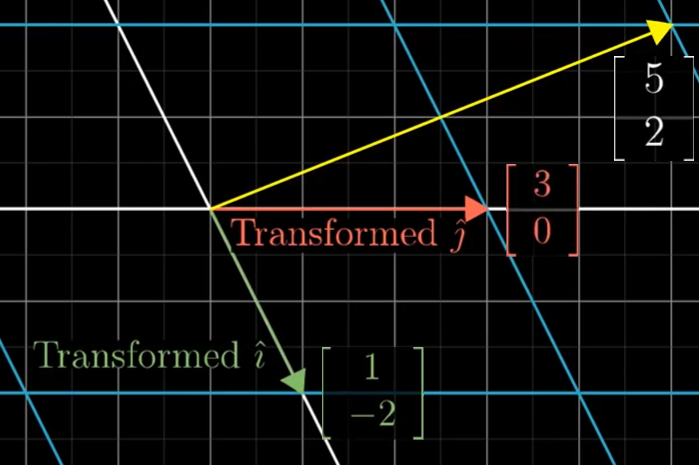
The matrix encodes two column vectors that specify where the two unit vectors (î and ĵ) end up when the vector space is transformed.

Figure 1 shows the two unit vectors (î and ĵ) before the linear transformation and Figure 2 shows the effect of the transformation on those two vectors.

Figure 2: After transformation of the vector space
To find out where any given vector ends up, simply multiply the vector by the matrix.

Consider the yellow arrow in Figure 1 which is represented by the vector

[-1]
[ 2]

Figure 2 shows the effect of the linear transformation on the yellow arrow. In numerical terms, the vector is multiplied by the matrix as follows [3]:

[ 1 3][-1] = -1[ 1] + 2[3] = [-11 + 2*3] = [5]
[-2 0][ 2]     [-2]    [0]   [-1*-2 + 2*0]   [2]

So the place where the vector ends up is -1 times the vector where i-hat ends up plus 2 times the vector where j-hat ends up. That is, the vector started off as a specific linear combination of i-hat and j-hat (-1î + 2ĵ) and it ended up as that same linear combination of where those two unit vectors ended up.

To summarize, a vector is an arrow in space and a matrix is a linear transformation of that space (say, a rotation). So to visualize the arrow in the transformed space, just multiply the vector by the matrix.

Figure 3: Rotate counterclockwise then shear right
It is also possible to apply multiple transformations in succession. In Figure 3, the original vector space is rotated then sheared. The overall effect is another linear transformation, called a composition, that is distinct from the rotation and the shear. The composition (or product) matrix can be calculated by multiplying the rotation matrix by the shear matrix, as follows:

[1 1][0 -1] = [1 -1]
[0 1][1  0]   [1  0]

Note that the first column of the composition matrix shows where i-hat ends up and the second column shows where j-hat ends up. Also note the right-to-left rule [3], so the rotation (blue) occurs first and is then followed by the shear (purple). Order matters, since a shear followed by a rotation would produce a different composition matrix (i.e., the green arrow would end up pointing in a north-west direction). Generally:

[ix2 jx2][ix1 jx1] = [ix1ix2 + iy1jx2   jx1ix2 + jy1jx2]
[iy2 jy2][iy1 jy1]   [ix1iy2 + iy1jy2   jx1iy2 + jy1jy2]

Breaking this down, i and j represent the columns where i-hat and j-hat end up for each matrix. So to calculate where i-hat and j-hat end up in the composition matrix, i and j in the first (blue) matrix each have to be transformed (multiplied) by the second (purple) matrix. So calculating where i-hat ends up first:

[ix2 jx2][ix1] = ix1[ix2] + iy1[jx2] = [ix1ix2 + iy1jx2]
[iy2 jy2][iy1]      [iy2]      [jy2]   [ix1iy2 + iy1jy2]

The transformed i-hat vector is the first column of the composition matrix. Similarly calculating where j-hat ends up:

[ix2 jx2][jx1] = jx1[ix2] + jy1[jx2] = [jx1ix2 + jy1jx2]
[iy2 jy2][jy1]      [iy2]      [jy2]   [jx1iy2 + jy1jy2]

The transformed j-hat vector is the second column of the composition matrix.

The final effect is that i-hat and j-hat are transformed as indicated by the two columns in the composition matrix. In this way, any number of transformations can be combined in the desired order to produce a new composition matrix.

Consider again the composition of the rotation and shear above. To visualize an arrow in the transformed space, just multiply the vector by the composition matrix. As shown above, the effect is exactly the same as applying the rotation then the shear, except that those two actions are applied in a single action. That is:

[1 1][0 -1][x] = [1 -1][x]
[0 1][1  0][y]   [1  0][y]

It is also possible to represent a transformation between dimensions. A matrix with 3 rows by 2 columns represents a 2D to 3D transformation, whereas a matrix with 2 rows by 3 columns represents a 3D to 2D transformation.

Next up: the determinant of a matrix

--

[1] The figures and examples of the posts in this series are based on the Essence of Linear Algebra series by 3Blue1Brown.

[2] Recall the unit vectors, where î (i-hat) is the arrow of unit length along the X-axis and ĵ (j-hat) is the arrow of unit length along the Y-axis.

Figure 4: Unit vectors

[3] Note that vectors and matrices are multiplied from right to left. The reason for this is that matrices are essentially functions. In function notation, the function M2(M1(V)) calculates from inner to outer which, visually, is from right to left. Note also that the order matters because matrix multiplication is non-commutative. That is M1M2 != M2M1.

Visualizing linear algebra: Vectors

Figure 1: Numeric and geometric
representation of a 2D vector
This is Part 1 in a series on linear algebra [1].

Geometrically, a vector is an arrow that has two components: a length and a direction. The yellow arrow in Figure 1 lives in a 2D vector space defined by a horizontal (X) dimension and a vertical (Y) dimension and with the tail of the arrow at the origin.

An equivalent numeric representation is as an ordered list of numbers. As shown in Figure 1, the column stores the coordinates of the vector from top to bottom in order of dimension (i.e., X then Y). A 2D vector can be represented generally as:

[x]
[y]

Figure 2: Vector addition
Vectors, like numbers, can be added. Geometrically, considering the two vectors that are to be added as arrows, this is done by moving the second arrow such that its tail is at the head of the first arrow. The sum is itself an arrow which extends from the tail of the first arrow to the head of the second arrow. In Figure 2, the summed arrow is represented by the purple arrow extending from the origin.

In the numeric representation, the sum vector is calculated by adding the coordinates for each dimension. Generally:

[x1] + [x2] = [x1 + x2]
[y1]   [y2]   [y1 + y2]

Figure 3: Vector multiplication (scaling)
Vectors can also be multiplied by a number. This number is called a scalar since it scales the vector by that number. In Figure 3, the original arrow is scaled by 2.

In the numeric representation, the product vector is calculated by multiplying each coordinate by the scalar. Generally:

s * [x] = [s * x]
    [y]   [s * y]


Figure 4: Linear combination of scaled unit vectors
In a 2D coordinate system there are two special vectors: i-hat (î) is the unit vector in the horizontal (X) direction and j-hat (ĵ) is the unit vector in the vertical (Y) direction.

Each of the coordinates in any given vector can be considered as scalars that scale the unit vectors. In Figure 4, i-hat is flipped (since the scalar is negative) and scaled by a factor of 5 while j-hat is scaled by a factor of 2. That is, the yellow arrow is the sum of the two scaled unit arrows.

When any vectors are scaled and added in this way, the resulting expression is a linear combination of those scaled unit vectors (which is, itself, a vector as geometrically represented by the yellow arrow in Figure 4). Generally:

v =  +

The span of the unit vectors is the 2D plane (the set of all their possible linear combinations). That is, any point on the 2D plane can be reached by a unique scaling of the two unit vectors. This is also true for most pairs of vectors except those that reside on the same line (in which case their span is just the 1D line and so these vectors are linearly dependent). The unit vectors are linearly independent and, for simplicity, are often chosen as the basis vectors for a 2D space as in Figure 4. This general idea also extends to three and higher dimensions where, for example, the span of the three unit vectors is the 3D volume.

Next up: matrices

--

[1] The figures and examples of the posts in this series are based on the Essence of Linear Algebra series by 3Blue1Brown.

Friday, 24 August 2018

What does science say about sexual orientation?

Sexual orientation: biology or choice?
The scientific research regarding sexual orientation has ongoing political, religious and social implications. This post highlights the specifically scientific conclusions on the causes of sexual orientation. I've structured it in a Question and Answer format with quotes from the relevant scientific literature.

In particular, a comprehensive meta-analysis study conducted by J. Michael Bailey and colleagues in the journal Psychological Science in the Public Interest in 2016 is referenced which provides a systematic review of the scientific research.


What percentage of people have a same-sex attraction?

From the 2016 meta-analysis study:
"Those with predominantly same-sex attractions comprise fewer than 5% of respondents in most Western surveys. Data from non-Western cultures are consistent with this conclusion. There is no persuasive evidence that the rate of same-sex attraction has varied much across time or place." [1]

What causes one's sexual orientation?

From the 2016 meta-analysis study:
"No causal theory of sexual orientation has yet gained widespread support. The most scientifically plausible causal hypotheses are difficult to test. However, there is considerably more evidence supporting nonsocial causes of sexual orientation than social causes. This evidence includes the cross-culturally robust finding that adult homosexuality is strongly related to childhood gender nonconformity; moderate genetic influences demonstrated in well-sampled twin studies; the cross-culturally robust fraternal-birth-order effect on male sexual orientation; and the finding that when infant boys are surgically and socially “changed” into girls, their eventual sexual orientation is unchanged (i.e., they remain sexually attracted to females). In contrast, evidence for the most commonly hypothesized social causes of homosexuality—sexual recruitment by homosexual adults, patterns of disordered parenting, or the influence of homosexual parents—is generally weak in magnitude and distorted by numerous confounding factors." [1]
To elaborate on the above nonsocial causes:
  1. Childhood gender nonconformity: "Behaving like the other sex—is a strong correlate of adult sexual orientation that has been consistently and repeatedly replicated." [1]
  2. Moderate genetic influences demonstrated in well-sampled twin studies: "Twin siblings of homosexual males are more likely to be homosexual than non-twin siblings." [4]
  3. The cross-culturally robust fraternal-birth-order effect on male sexual orientation: "The number of biological older brothers, including those not reared with the participant (but not the number of nonbiological older brothers), increases the probability of homosexuality in men. These results provide evidence that a prenatal mechanism(s), and not social and/or rearing factors, affects men’s sexual orientation development." [4]
  4. When infant boys are surgically and socially “changed” into girls, their eventual sexual orientation is unchanged (i.e., they remain sexually attracted to females): "These results comprise the most valuable currently available data concerning the broad nature-versus-nurture question for sexual orientation. They show how difficult it is to derail the development of male sexual orientation by psychosocial means." [1]

From Wikipedia:
"Biological theories for explaining the causes of sexual orientation are favored by scientists and involve a complex interplay of genetic factors, the early uterine environment and brain structure. These factors, which may be related to the development of a heterosexual, homosexual, bisexual, or asexual orientation, include genes, prenatal hormones, and brain structure." [2][3]

What are the relevant peer-reviewed scientific studies?

  • The 2016 meta-analysis has a comprehensive survey of the scientific research [1].
  • A summary of 19 peer-reviewed studies relevant to the question Is sexual orientation determined at birth? Of the 19 studies, 15 conclude in the affirmative, one in the negative and three are non-conclusive. [4]

Is the presence of same sex orientation in the population a Darwinian paradox?

From Australia’s Science Channel:
"Jenny Graves, professor of genetics at LaTrobe University in Melbourne, has no problem with the concept of gay genes.

'The idea that a person’s genetic makeup affects their mating preference is unsurprising,' she writes in The Conversation. 'We see it in the animal world all the time. There are probably many genes that affect human sexual orientation.'

But rather than thinking of them as 'gay genes', perhaps, she says, we should consider them “male-loving genes”.

'They may be common because these variant genes, in a female, predispose her to mate earlier and more often, and to have more children.'

Graves cites an Italian study [5] that shows female relatives of gay men having 1.3 times as many children as the female relatives of straight men. One possible explanation is that “male-loving” alleles – our gene variants – in a female they predispose her to mate earlier and have more children, so making up for the fewer children of gay males." [6]

References:

[1] "Sexual Orientation, Controversy, and Science", Psychological Science in the Public Interest, 2016.

[2] https://en.wikipedia.org/wiki/Biology_and_sexual_orientation

[3] https://en.wikipedia.org/wiki/Sexual_orientation

[4] Peer-Reviewed Studies on the Origin of Sexual Orientation Since 1990

[5] "Evidence for maternally inherited factors favouring male homosexuality and promoting female fecundity", Proceedings, Biological Sciences, 2004

[6] https://australiascience.tv/science-of-sexuality/

Wednesday, 16 May 2018

The liar paradox (Part 2)


In my previous post I discussed the liar paradox and argued that it should not be considered either true or false because it is cyclic. That is, it never ends up successfully asserting anything about the world.

Interestingly, the Stanford Encyclopedia of Philosophy (SEP) entry for the Liar Paradox outlines an argument that the liar sentence implies a contradiction. The argument uses two inference rules, as follows:

  • Capture: A implies "A" is true
  • Release: "A" is true implies A

Taking these two rules together, the terms A and "A" is true are intersubstitutable [1]. The SEP argument, reproduced in plain English [2], is:

Let L be the sentence, "This sentence is not true".

    1. "L" is true or "L" is not true [Law of Excluded Middle]
    2. Case One:
         a. "L" is true
         b. L [2a: release]
         c. "L" is not true [2b: definition of L]
         d. "L" is true and "L" is not true [2a, 2c: conjunction introduction]
    3. Case Two:
         a. "L" is not true
         b. L [3a: definition of L]
         c. "L" is true [3b: capture]
         d. "L" is true and "L" is not true [3a, 3c: conjunction introduction]
    4. "L" is true and "L" is not true [1-3: disjunction elimination]

Line 1 assumes that the liar sentence conforms to the Law of Excluded Middle. That is, it assumes that the liar sentence is either true or not true and not some other value. Lines 2 and 3 analyze each disjunct as separate cases. In each case a contradiction is reached which is then inferred in 4.

The conclusion that the liar sentence implies a contradiction depends on the first premise being truth-apt. However, as argued previously, the liar sentence is not truth-apt and so therefore the first premise can't be either. Consequently logical inference rules and truth evaluation aren't applicable to it. A contradiction is only reached via a false assumption of truth-aptness.

The rule of thumb would be that a sentence is only truth-apt if it is grounded in a state of the world either directly or else indirectly via other sentences. Note that this condition fails for both the simple liar (where not true means false) and the strengthened liar (where not true means false or not truth-apt).

--

[1] This is Alfred Tarski's T-Schema: 'S' is true if and only if S (e.g., 'snow is white' is true if and only if snow is white).

[2] For example, I've replaced the corner symbols that indicate quasi-quotation with ordinary quotes.

Wednesday, 28 February 2018

The liar paradox

Consider our friend Pinocchio who says, "I am lying". Is his statement a lie? Or does he speak truly? It seems that if he is telling the truth, then he must be lying, just as he says. In which case he is not telling the truth. But if he is not telling the truth, then he is indeed lying. Just as he truly says!

This is known as the liar paradox. It seems that there is no satisfactory answer for whether Pinocchio is lying or speaking the truth. There are many variations of this paradox. For example, "Epimenides was a Cretan who made one immortal statement: 'All Cretans are liars.'". Another is the sentence, "This sentence is false."

In this post I will offer an explanation for the why the paradox occurs that builds on Gilbert Ryle's analysis [1].

The first thing that is usually noticed is that the statement, "This sentence is false." refers to itself. So perhaps self-reference is the problem. But we use self-reference all the time. For example, "I have a blue shirt on" is a perfectly valid statement. As is, "This sentence has five words".

So perhaps the problem is the way that the statement refers to itself. To evaluate whether the sentence is false first requires evaluating the truth value of the referring expression, namely 'This sentence'. That referring expression is just the original sentence. So that sentence, in turn, first requires evaluating the truth value of its referring expression, namely 'This sentence'. We can see that this is a recursive expression that never terminates in an evaluable statement. So it is not truth-apt [2].

But this raise the question as to why the statement, "This sentence has five words" doesn't have the same unending recursion. This statement expands as, "'This sentence has five words' has five words". We naturally stop at this point and just count the words in the inner sentence. But what is the rule for why we should stop? Shouldn't it expand indefinitely as well? One answer is that this sentence is grounded [3]. That is, the recursive expansion terminates in a sentence that doesn't mention truth.

However one can then go on to create strengthened liars such as, "This sentence is false or not truth-apt". If it is true, then it is false or not truth-apt, so it is not true. If it is false, then it is true, so it is not false. If it is neither true nor false then it is not truth-apt. Which is what the sentence says, so it is true! So it seems there is no satisfactory answer to the strengthened liar. However one approach here is to say that since the sentence is demonstrably not truth-apt, then it should not be subsequently read as making a truth-apt claim. It is a kind of illusion - it appears to be truth-apt but it is not.

A shortcoming of the above approach is that that there doesn't seem to be a principled rule to apply to determine whether a liar-style sentence is truth-apt. One just plugs in values and tries to find a custom solution. If a solution is found, then a new strengthened liar is constructed to foil it (these are also aptly called revenge liars!) And we don't seem closer to understanding what it is that makes liar-style sentences defective.

The approach I take instead involves distinguishing between use and mention. My claim (on ordinary use grounds) is that only the use of statements can be truth-apt whereas mentions of statements are not truth-apt (and treating them as if they were is a category mistake). When we mean to mention a statement rather than use it, we enclose the statement in quotation-marks. Consider the sentence, "This sentence has five words". This expands as "'This sentence has five words' has five words". The inner sentence is mentioned and thus (per my claim) is not truth-apt. This isn't an issue here since a truth predicate is not being used and the sentence is readily evaluable with the predicate it does have.

But what about a statement like "'Snow is white' is true"? Since that statement does evaluate as true, it seems that a mention of a statement can be true after all. My claim is that this is not the case. Instead, in ordinary use, a truth-predicate has a disquotation function [4]. That is, it removes the quotation marks and uses the statement. Thus, the statement ""Snow is white' is true" is transformed to "Snow is white" which (when used) is a truth-apt statement. More generally, "'p is q' is true" becomes "p is q" and "'p is q' is false" becomes "Not (p is q)". I will term this the disquotation rule.

Now consider the liar sentence, "This sentence is false". This expands as, "'This sentence is false' is false". Note that the inner sentence is mentioned, not used, so it is not truth-apt. However, since a truth predicate is specified, the disquotation rule can be applied. So applying this rule to the liar sentence, we get:
  1. This sentence is false
  2. "This sentence is false" is false [mention]
  3. Not ("This sentence is false" is true)
  4. Not (This sentence is false) [disquotation]
  5. Not ("This sentence is false" is false) [mention]
  6. "This sentence is false" is true
  7. This sentence is false [disquotation]

What emerges is that the liar sentence is cyclic (line 7 is identical to line 1). We can also apply this rule to the truth-teller sentence:
  1. This sentence is true
  2. "This sentence is true" is true
  3. This sentence is true

Thus the truth-teller is also cyclic. We can also test this approach with a conventional self-referring sentence:
  1. This sentence has five words
  2. "This sentence has five words" has five words
  3. True

So the sentence is indeed truth-apt. The nice thing about applying the disquotation rule is that there is no need to plug in values and test each one. We can just follow the logic of the statement and note whether it terminates in a truth-apt value or, else, cycles.

Now consider the strengthened liar:

Let L be the sentence, "This sentence is false or not truth-apt".
  1. L
  2. "L" is false or not truth-apt
  3. "L" is false or "L" is not truth-apt
  4. Not ("L" is true) or ("L" is not true and "L" is not false)
  5. Not (L) or (not "L" is true and "L" is true)
  6. Not L or (not L and L)
  7. Not L or false
  8. Not L
  9. Not (not L) [substituting 8 into 1]
  10. L

Thus the strengthened liar is cyclic and so is not truth-apt. But isn't this just what the strengthened liar says? Since it has been demonstrated that it is cyclic, its apparent truth-aptness is an illusion. Just as a straight stick can appear bent when partially submerged in water, so to a cyclic statement can appear truth-apt when it is actually not.

In conclusion, the reason why the liar sentence (and any strengthened liar) is not truth-apt is because the self-reference is cyclic. Conventional (non-cycling) self-reference is fine. [5]

For more paradoxical fun, see Part 2.

--

[1] From "Heterologicality", Gilbert Ryle, 1951:

"The same inattention to grammar is the source of such paradoxes as 'the Liar ', 'the Class of Classes ...' and 'Impredicability'. When we ordinarily say 'That statement is false ', what we say promises a namely-rider, e.g. '... namely that to-day is Tuesday'. When we say 'The current statement is false' we are pretending either that no namely-rider is to be asked for or that the namely-rider is '... namely that the present statement is false'. If no namely-rider is to be asked for, then 'The current statement' does not refer to any statement. It is like saying 'He is asthmatic' while disallowing the question 'Who?' If, alternatively, it is pretended that there is indeed the namely-rider, '... namely that the current statement is false', the promise is met by an echo of that promise. If unpacked, our pretended assertion would run 'The current statement {namely, that the current statement [namely that the current statement (namely that the current statement ...'. The brackets are never closed; no verb is ever reached; no statement of which we can even ask whether it is true or false is ever adduced.

Many of the Paradoxes have to do with such things as statements about statements and epithets of epithets. So quotation-marks have to be employed. But the mishandling which generates the apparent antinomies consists not in mishandling quotation-marks but in treating referring expressions as fillings of their own namely-riders."

[2] For a sentence to be truth-apt means that it is either true or false. Sentences like "Hello!" or "Twas brillig, and the slithy toves" are not truth-apt. A cyclic sentence like the liar sentence is also not truth-apt. (Note: an alternative view, called dialetheism, regards the liar sentence as both true and false.)

[3] Saul Kripke, 1975, “Outline of a theory of truth”.

[4] Disquotation is the reversal of the process of quotation. It transforms a quoted statement into an actual statement. That is, it uses the mentioned statement. For example "'Snow is white' is true" just means "Snow is white".

[5] Two more interesting sentences are worked out below:

Let L be the sentence, "This sentence is truth-apt".
  1. L
  2. "L" is truth-apt
  3. "L" is true or "L" is false
  4. "L" is true or not "L" is true
  5. L or not L
  6. True [Law of excluded middle]

Let L be the sentence, "This sentence is not truth-apt".
  1. L
  2. "L" is not truth-apt
  3. "L" is not true and "L" is not false
  4. Not "L" is true and "L" is true
  5. Not L and L
  6. False [Law of non-contradiction]

Tuesday, 27 February 2018

Hylomorphism

Aristotle's hylomorphism
In a previous post I discussed the problem of universals. Briefly, Plato held that universals (like redness, roundness and numbers) exist in a higher realm of the Forms.

On the other hand his pupil, Aristotle, held that universals are immanent in particular things in the everyday, natural world. In fact, he considered every physical thing (termed a particular or a substance) to be an inseparable compound of matter and form. This view is called hylomorphism, where the Greek word hule means matter and morphe means form.

Consider a coffee cup. It has a round rim. For Aristotle, the roundness of the rim (a universal) is part of the form of the cup. So too are the cup's other identifiable characteristics such as its color and weight. But the cup also has a material aspect - it's made of ceramic. Without that material there would be no cup. Similarly, without the form, there would also be no cup. Thus the cup necessarily consists of both matter and form. It's not possible to extract the roundness of the rim or the weight of the cup - the form is inseparable from the cup.

Nonetheless we can think about the roundness of the rim or the weight of the cup. We can even think about a circle as a geometric shape separate from any particular thing at all, consider its geometric properties, and transform it to, say, an oval. This is a process of abstraction. The form is in the cup, but we can think about it in a purely formal manner separate from the cup. That separation is epistemic, not ontological - there are no formal circles floating around the universe apart from the particular cups, checker pieces and rings that exhibit that form.

For Aristotle, hylomorphism is applicable to all things, from atoms to plants, animals and humans. In the case of human beings, Aristotle is the particular (or primary substance), his body is the matter and his soul is the form. The species and genera are secondary substances. So human being and animal are secondary substances of Aristotle.

It's interesting to compare Aristotle's view to the modern view where the hard sciences are considered to be concerned primarily with matter, hence the prominence of materialism. Aristotle's broader naturalism, on the other hand, fully includes notions of purpose, meaning, morality, intentionality and everyday experience. For Aristotle, all things are a holistic integration of form and matter. And it is in our experience of things that we discover their true form (nature).

Thursday, 25 January 2018

Do ducks lay eggs?

Aristotle - De Anima (On the Soul)
Ducks lay eggs. True or false? Most people regard the statement as unquestionably true.

Sentences like this are called generics and the interesting feature of generics is that they tolerate exceptions.[1] For example, male ducks don't lay eggs and neither do female ducks that lack the capability due to defects. Yet most of us accept that the statement conveys real information about ducks as a species, despite such exceptions in individual ducks.

Generic sentences are problematic on a nominalist view since universal terms (such as "duck") are considered to be nothing more than a collective name for individuals.[2] So the sentence "ducks lay eggs" would seem to imply a hidden "all" quantifier and thus really means "all ducks lay eggs". So on a nominalist reading "ducks lay eggs" is considered either strictly false or perhaps not a legitimate knowledge claim at all. Whereas realists about universals hold that generic statements differ in meaning from statements that include quantifiers. That is, generic statements refer to universal categories or kinds, not to the individual members of those categories or kinds.

Greg N. Carlson explains the key feature of generics as follows:
Finally, to re-emphasize a point made by Goodman (1955) and more recently by Dahl (1975) (among a host of others), the truth of generics depends on a notion of non-accidental generalization for their truth. The world contains in its extension all manner of possible patterns and convergences, many of which we judge to be purely accidental, but others of which we take to be principled. Only the principled patterns are taken to support true generics.
Truth-Conditions of Generic Sentences: Two Contrasting Views
In Aristotelian terms, this generic meaning is captured by the distinction between essence and accident. One familiar example is the Aristotelian definition of humans as the rational animal. This definition successfully distinguishes between humans as a species and other animal species that lack that rational capability.[3] This is so even though individual exceptions exist. For example, a two-week old embryo, a comatose or sleeping human, or a human acting irrationally.

--

[1] For a brief overview, see Generic Sentences and Predication.

[2] See my previous post on the problem of universals.

[3] For an interesting analysis of this definition, see Essentially Rational Animals.